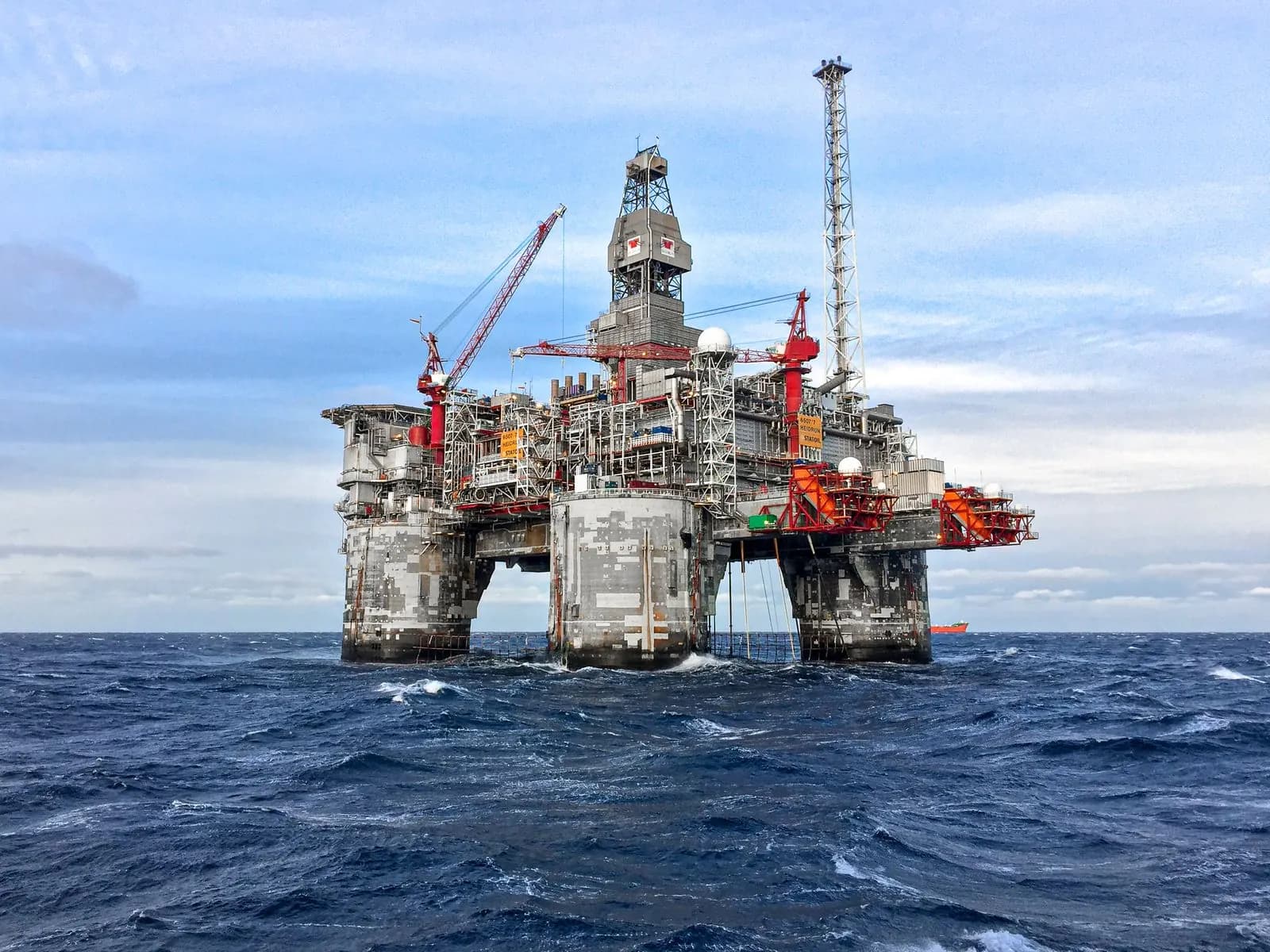
Oil and gas
Oil platform worker (North Sea)
Work at offshore oil and gas facilities in Norway and the United Kingdom: GSK or BOSIET, offshore medical check, rotation schedule.
Photo: Jan-Rune Smenes Reite / Pexels
- Pay
- ≈ $8 890
- NOK 87,080 · median, per month · gross (before tax) · Norway
- Experience
- No verified data
- Work pattern
- Rotation work
- English
- No verified data
- Jobs
- 2
- current, from official sources
About the profession
Working on offshore oil and gas installations in the North Sea requires basic safety training: in Norway, GSK under the Offshore Norge programme (including helicopter underwater escape training, HUET); in the UK, OPITO BOSIET with CA-EBS. Norway recognises equivalent training from the UK, the Netherlands and Denmark.
On the Norwegian continental shelf, the law limits the rotation: a stay on the installation of up to 14 days, with rest between rotations of at least one third of the length of the previous stay.
Pros
- A rotation schedule with legally guaranteed rest (Norway)
- Safety training is recognised between Norway, the UK, the Netherlands and Denmark
Cons
- Long periods at sea, isolation
- Certificates must be renewed regularly (GSK every 4 years)
- Increased occupational risks, so training and health requirements are correspondingly strict
Pay
NOK 87,080
median per month · gross (before tax)
≈ $8 890 at the ECB rate of 24.11.2026
SSB, таблиця 11419: медіанний місячний заробіток у галузі «Видобуток нафти й газу, включно з допоміжною діяльністю» (SN2007 06+09.1), усі професії, усі сектори, усі працівники. Середнє — 96 350 NOK. Включає базову ставку, нерегулярні доплати (зокрема за офшор і зміни) та бонуси; без понаднормових. Неповний робочий час перераховано на повну ставку; звітний місяць — листопад.
NOK 81,580
median per month · gross (before tax)
≈ $8 330 at the ECB rate of 24.11.2026
SSB, таблиця 11419: медіана для групи «Оператори установок і машин» (STYRK 8) у видобутку нафти й газу та допоміжній діяльності (06+09.1). Середнє — 82 020 NOK. Для «Елементарних професій» (STYRK 9) медіана — 74 870 NOK. Без понаднормових.
NOK 80,180
median per month · gross (before tax)
≈ $8 190 at the ECB rate of 24.11.2026
SSB, таблиця 11418: медіана для професії STYRK 8113 «Бурильники свердловин і споріднені працівники», усі галузі й сектори, усі працівники. Середнє — 80 360 NOK. Без понаднормових.
£1,672.10
median per week · gross (before tax)
≈ $2 190 at the ECB rate of 24.11.2026
ONS ASHE, таблиця 4.1a: медіанний валовий тижневий заробіток працівників повного дня в галузі SIC 06 «Видобуток сирої нафти й природного газу» (Велика Британія). Включає всіх працівників галузі, не лише офшорних. Середнє — 1820,3 GBP. Дані попередні; коефіцієнт варіації медіани — 11%.
Requirements
Every requirement has a source next to it. A country tag means the requirement applies only there; a citizenship tag means it applies only to that group of candidates.
Licences and certificates
OPITO standard for those going offshore for the first time: 5 modules, valid for 4 years. Having the certificate does not replace BOSIET or an offshore medical certificate.
For marine personnel with STCW certificates on mobile and floating installations, STCW training is considered equivalent to GSK, and it must be renewed every 5 years (not 4). They must complete helicopter underwater escape training (HUET) at a centre approved by Offshore Norge and repeat it every 5 years.
Members of the emergency response team complete a separate basic course and refresher courses: search and rescue team, rescue boat coxswain, MOB boat crew, first aid team, helicopter landing officer (HLO), on-scene commander, emergency management.
Age, language, experience, education
Offshore oil and gas workers must be 18 years old at the start of work (rammeforskriften § 36).
- Safety training from countries outside the North Sea Agreement is not automatically recognised🇳🇴 Norway only[1]
Norway recognises basic safety training only from the United Kingdom, the Netherlands and Denmark (the North Sea agreement). Training from other countries, including Ukraine, is not recognised for the Norwegian continental shelf; an operator or vessel owner may accept it only on a case-by-case basis.
Required documents
Documents, medical check, visa and permits
Required at all times; valid for up to 2 years (up to 1 year for work under increased pressure).
Medical checks for work in the British offshore sector are governed by OEUK guidelines (Issue 8.2, August 2026).
Preparation costs
Only amounts from official sources. We don't add up a total: prices depend on the country and the training centre.
Step-by-step plan
- 1
Decide on a sector: the Norwegian or British continental shelf
- 2
- 3
- 4
Look for vacancies with operators and contractors
- 5
Check that you are already 18 years old (mandatory for the Norwegian continental shelf) (Norway)[1]
- 6
- 7
For the UK continental shelf: consider the OPITO MIST course for beginners (United Kingdom)[1]
5 modules, two days, valid for 4 years. BOSIET is still required before going to sea.
Latest jobs
All 2 →Forpleiningsleder offshore
Cares · 🇳🇴 Norway, Stavanger
Salary not statedFull-timeyesterdaySource: NAV Arbeidsplassen (Норвегія)
Norwegian a plusTraining providedRotation
Fagskolen i Finnmark, avd. Nordkapp - NKSS søker fagansvarlig instruktør maritim/ offshore
Finnmark fylkeskommune (FFK) · 🇳🇴 Norway, Vadsø
Salary not statedFull-time2 days agoSource: NAV Arbeidsplassen (Норвегія)
Don't miss your chance
Get new jobs for the professions you choose straight to Telegram.
Frequently asked questions
GSK or BOSIET?+
GSK is required for the Norwegian continental shelf; Norway recognises equivalent training from the UK (OEUK), the Netherlands (Nogepa) and Denmark. BOSIET with CA-EBS is the British OPITO standard.
How long is GSK valid?+
48 months from the last GSK course or refresher. If it is not renewed for 8 years, you must take the full course again.
What is the work schedule?+
In Norway, a stay on the installation is up to 14 days, with rest between rotations of at least one third of the previous stay, and up to 12 hours of normal work per day.
Related reading
Sources of information
- 1.OPITO: BOSIET with CA-EBSOPITO · verified 24 November 2026
- 2.Norwegian Oil and Gas (Offshore Norge) Guideline 002: Recommended guidelines for safety and emergency response training, rev. 24 (20.06.2022)Offshore Norge (formerly Norwegian Oil and Gas) · verified 24 November 2026
- 3.Rammeforskriften (FOR-2010-02-12-158)Lovdata · verified 24 November 2026
- 4.Forskrift om helsekrav for personer i arbeid på innretninger i petroleumsvirksomheten til havs (FOR-2010-12-20-1780)Lovdata · verified 24 November 2026
- 5.OEUK Medical Guidelines – Issue 8.2 (August 2026)Offshore Energies UK (OEUK) · verified 24 November 2026
- 6.OPITO Minimum Industry Safety Training (MIST) StandardOPITO · verified 24 November 2026
- 7.SSB StatBank table 11419: Monthly earnings, by occupation, sector, industry (SIC2007) — 06+09.1 Oil and gas extraction incl. support activities, 2025Statistics Norway (SSB) · verified 24 November 2026
- 8.Earnings — About the statistics (definitions of monthly earnings)Statistics Norway (SSB) · verified 24 November 2026
- 9.SSB table 11418: Monthly earnings by occupationStatistics Norway (SSB) · verified 24 November 2026
- 10.Earnings and hours worked, industry by two-digit SIC: ASHE Table 4, 2026 provisional — Table 4.1a Weekly pay, gross, full-timeOffice for National Statistics (ONS) · verified 24 November 2026
Verified 24 November 2026
Spotted an error? Let us know — we'll check it and fix it.